tcgsearch: A Platform for Collectors and Vendors
Overview
Role: Co-Founder, Product and UX Lead
Timeline: 2025 to Present
Team: Two people, a designer (me) and an engineer
Live product: tcgsearch.com
tcgsearch is a trading card discovery platform that helps collectors and shop owners search, price, and trade cards. I led product strategy, UX, and growth, taking it from a concept to a live product with a growing, active user base.
Who I designed for
Two people sit on opposite sides of the same counter.
- The collector hunts for cards and wants a fast, trustworthy answer to one question: what is this worth right now. They also organize a growing collection and trade with friends.
- The shop runs trades over the counter. It needs to price a customer's pile quickly and fairly, then keep every trade on the record.
The collector does the research. The shop turns it into a transaction. The whole product is built around that handoff.
The problem
The trading card market is huge, but the tools around it were scattered and slow.
- Searching across marketplaces was clunky and time consuming.
- Pricing was opaque, with little clarity by condition or printing.
- Trade lists and inventory lived in manual spreadsheets.
- Mobile pricing, the exact moment it was needed at a show or a counter, was painful.
- Trades came down to trust, with no shared source of truth on a fair number.
The bets
I focused the product on three bets, each aimed at a real gap.
- Fast, flexible search. One place to find the exact card by name, set, or number, across multiple games.
- Price intelligence. Real-time market value by condition and printing, with the sources shown, so the number can be trusted.
- Trade management. Digital binders, a price calculator, and shop trade tools that turn a valuation into a transaction.
Research and method
Before designing anything, I went where the users already were.
Talking to people in context. I spent time in trading card forums, Discord groups, and local shops, watching how collectors searched by name, set, and number, and how vendors priced cards by hand at shows. Two patterns stood out: mobile access was essential, and when it came to ungraded cards, the TCGplayer marketplace is the gold standard.
Competitive analysis. I studied TCGPlayer, eBay, Cardmarket, and Price Charting to find where they fell short: slow filters, cluttered interfaces, weak real-time pricing, and no solution for quickly calculating buy back percentage.
Collectors do not want to compare endless listings. They want a quick, reliable answer to one question: what is this card worth right now?
Synthesis: the customer journeys
I mapped the full experience end to end on both sides of the platform. Six journeys carry the two personas from their first action to the outcome they care about, with the decisions and edge cases that shape each step. This is the artifact I used to align on scope and to keep the build anchored to how the product should actually feel.
Customer journeys
Six end-to-end journeys, two personas
Each timeline follows one persona from their first action to the outcome they care about, with the key decisions and edge cases called out underneath. Pick a card to open its journey.
00 · The big picture
Collectors research, value, and build collections. Shops run the trades and keep the records. A collector's cards become a shop's trade the moment they reach the counter.
Collector · Journey 01
Find a Card's Value
By the end: Knows what the card is worth, who is selling it cheapest, and what it has actually been selling for.
8 steps · 3 branches
- 1Search
Searches for a card by name
Types the card into search and scans the results grid of matching cards.
“Let me see what this one is going for.”
- 2Search results
Picks the right printing
Sets and printings can look alike, so they match the art, set, and number before clicking through.
- 3Card detail
Lands on the card page
The large market price sits up top, with a note on how recently it was updated.
“Okay, that is the going rate.”
- 4Card detail
Narrows to their exact copy
Chooses printing, condition, and language. Every number on the page refreshes to match.
- 5Verified listings
Checks the cheapest sellers
Lowest prices from verified sellers lists the top sellers with shipping and a total, ready to buy.
“Who has it cheapest once shipping is in?”
- 6Recently sold
Reads what it actually sold for
The recently sold table shows real sales, with a trend arrow and a percent change up or down.
- 7Card detail
Buy now or keep watching
Opens a seller on TCGplayer to buy, or notes the number and waits for the price to move.
- 8Card detail
Has a number they trust
Market value, the lowest verified seller, and recent sales all line up into one confident figure.
“Now I know what it is worth.”
Branches & edge cases
- at step 4 · No data for that variantIf a printing or condition has no sellers or sales, the page says so plainly. They switch to a more common variant to get a read.
- at step 5 · Wants the full listSee all and View on TCGPlayer open the card on TCGplayer with the chosen printing and condition already selected.
- at step 6 · Sanity-checks the averageSelecting individual rows in the sales table recalculates the average, so an obvious outlier can be ignored and the price set from the sales that look normal.
Watch out Market price is a snapshot, and the page notes how long ago it updated. A card with only a few recent sales, or one wild outlier, is harder to value. The app trims extreme sales automatically, but thin data is still thin data.
Collector · 01 / 06
Balancing user needs with business goals
I could not ship all six journeys at once, so I scoped hard for the first release. The MVP focused on the collector's core loop, search and value, on a single game where I could validate fastest.
- Pokemon card search
- Real-time pricing from TCGPlayer
- Basic buy back calculator built in
Shop tools, multi-game support, and trade history all came later, once the core loop had proven out with real users.
Explorations and trade-offs
Not every idea survived contact with real use.
One search bar, then two. The first design centered on a single main search. It was great for finding one card, but it slowed down shop owners looking up many cards in a row. We added a secondary side search for fast successive lookups, and it became one of the most used features among power users.
Vendor tools, later than they deserved. I treated shop tools as a follow-on. They turned into a core value driver. If I ran it again, I would bring the shop side forward sooner.
Team and collaboration
tcgsearch was a two person effort: I owned product, UX, and growth, and my engineering partner owned the build, devops, and more. Rather than hand off static mockups, we built a working prototype in Nuxt with real data and tested it together. We partnered with a local card shop to put early builds in front of actual trades, and I ran a direct feedback loop through an active Discord community, with daily input from collectors and shop owners feeding straight into the roadmap.
The product
On both sides of the counter
A look at the screens behind the journeys, from a collector pricing a single card to a shop running a trade end to end.
Collector
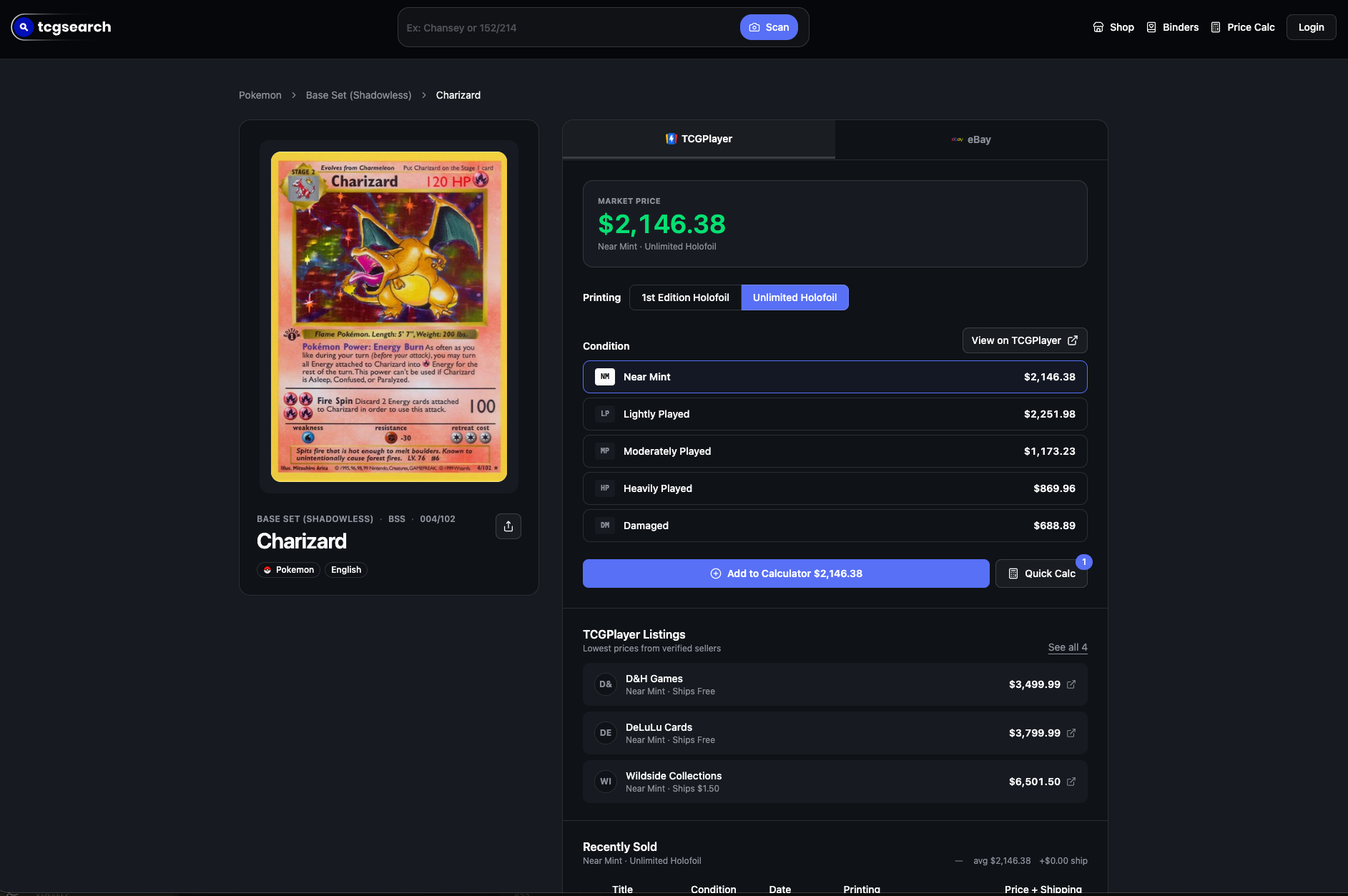
A number you can trust
The card page resolves market price, the lowest verified seller, and recent sales into one confident figure, narrowed to the exact printing, condition, and language.
Collector
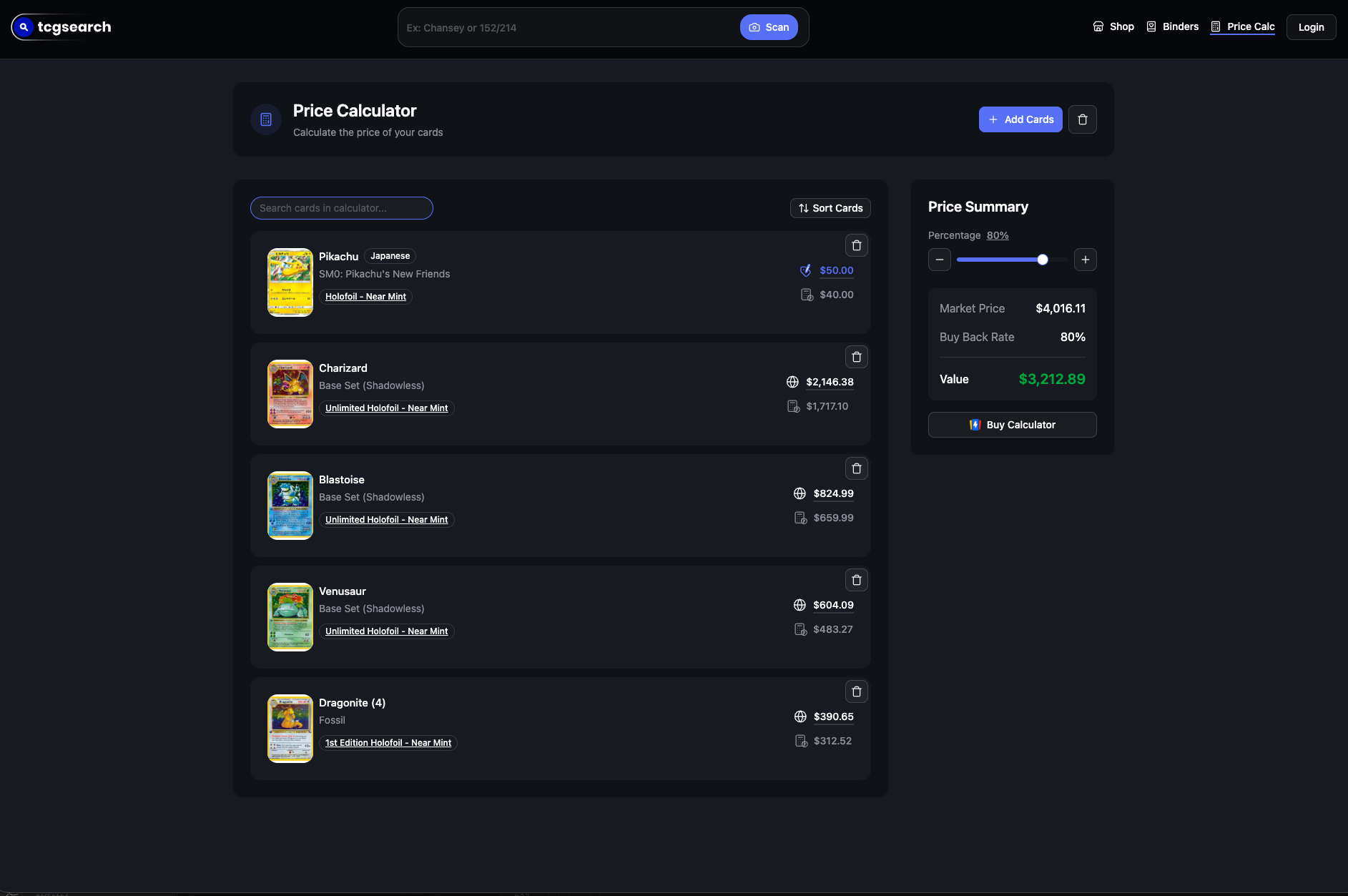
Price a whole pile in minutes
The price calculator totals a stack of cards and sets a fair offer at a chosen percentage, recalculating live as you drag the rate. It is the on-ramp from valuing one card to valuing a trade.
Collector
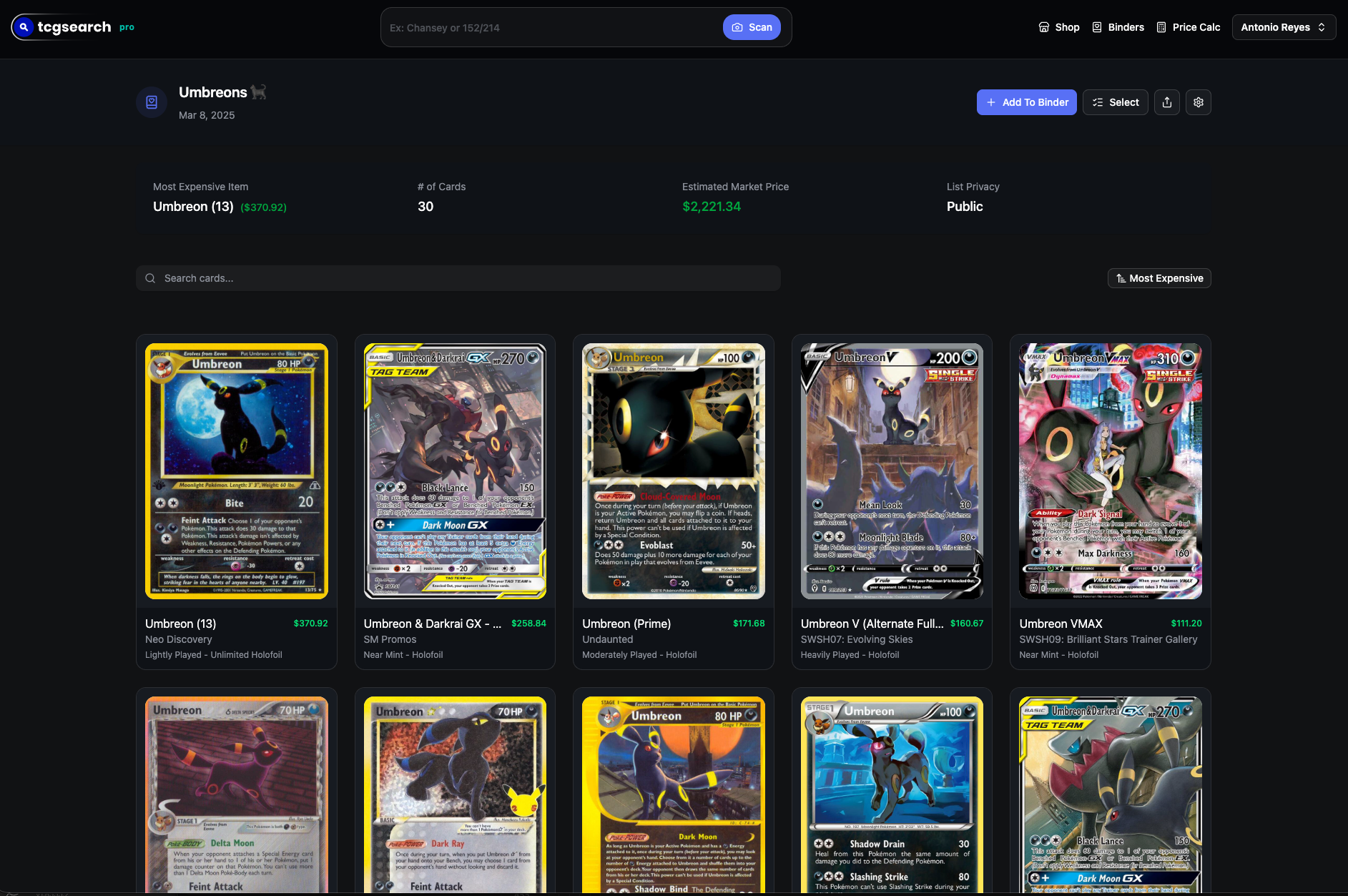
Collections worth sharing
Digital binders organize a collection or a want list, with per-card condition and printing, behind a single link that opens a clean, read-only view for friends.
Shop
Run a trade, keep the record
Shop tools price a customer's cards, set a buy-back rate, and complete the trade, locking it to the record. Every trade stays searchable by card, months later, with what was paid and when.
Outcomes
tcgsearch went from an idea to a live product people use every week.
- 200,000+ monthly page views and rising
- 10,000+ active monthly users
- About 25 minutes average session time
- An active Discord community with hundreds of members
- Approved as a TCGPlayer affiliate partner
- Expanded from Pokemon to five games: Pokemon, Magic, Yu-Gi-Oh, One Piece, and Riftbound
We can say with complete confidence this tool has made us hundreds of thousands of dollars.
SWFL Shop Owner
The biggest lessons held up: validate fast with a working prototype, build a feedback loop with real users, and bring the highest-value persona forward sooner. The shop side became a core driver, and I would prioritize it earlier next time.
tcgsearch is how I work: find the real gap, prove it with something live, and stay close to the people using it from the first sketch through launch and growth.